Andrew Spaulding
Andrew Spaulding
Bolinas Community Public Utilities District, California
“If I didn't have this job, we wouldn't be able to live here, for sure. Who knows where we'd be, but I wouldn't be able to be here.”

Date: March 16, 2026
Interviewer: Erin Elder
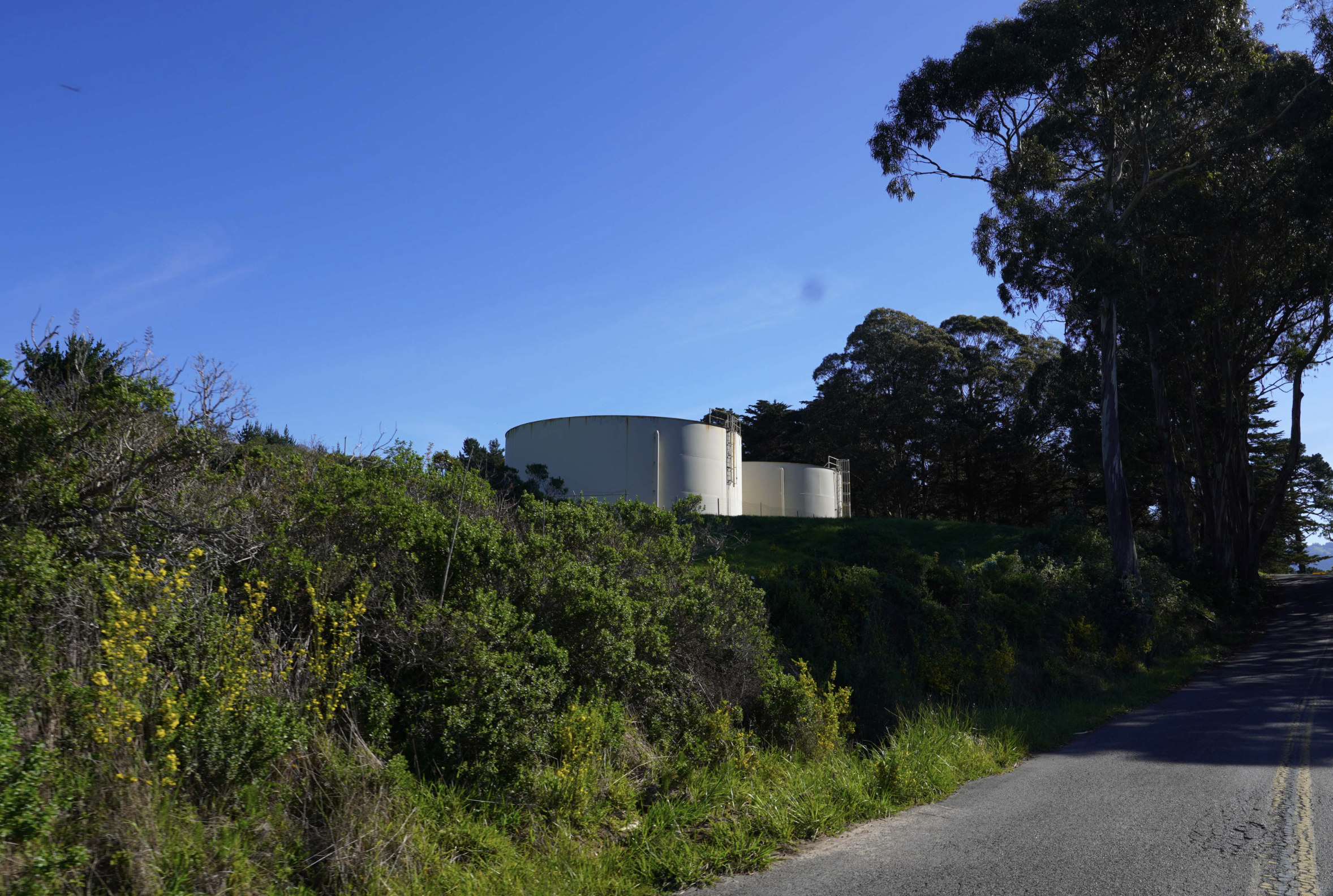
Andrew Spaulding never imagined he would become a water operator. Originally from Missouri, he came to California after a winding path that included photography school and a career in photography. Through his wife, whose family has deep roots in Bolinas, he became part of the small coastal community and eventually traded a long daily commute to San Francisco for a job close to home. A friend who worked for the Bolinas Community Public Utility District first introduced him to the field, and when a position opened up, Spaulding applied. More than nine years later, he serves as Interim Chief Operator, overseeing the water and wastewater systems that help sustain one of California's most distinctive towns.
Bolinas is defined in many ways by water. A longstanding water moratorium limits growth, and the town depends on a small creek for its supply. With only a few hundred water connections and a utility staff of three, operators are responsible for nearly every aspect of the system. Spaulding has come to know both the infrastructure and the people intimately. He estimates that he knows most residents by name, and his work often extends beyond pipes and pumps to helping neighbors understand and care for the systems that support the community. Whether responding to leaks, maintaining aging infrastructure, or planning for drought, he sees his role as one of constant observation and adjustment—making small changes each day to keep the town in balance.
What Spaulding enjoys most is that no two days are the same. Mentored by longtime operator Billy Pierce, he learned to approach each problem with patience and resourcefulness, confident that solutions can be found even when situations are unfamiliar. For him, the work is deeply tied to place. It allows him to remain in Bolinas, raise his family there, and contribute to a community he now considers home. While water systems are often invisible to the people they serve, Spaulding finds satisfaction in helping ensure that life in Bolinas continues to function as seamlessly as possible.

Interview
Summer Puddles and Infrastrucutre
AS: This morning, driving around, I thought I saw a leak on a road that's very common and drove up to him and started poking where, you know, it is and saw the homeowner. They instantly were like, "no, don't worry, we were washing our boat." You know, like right there…
I'm very keen on looking for summer puddles. I have a four-year-old, so we're constantly walking town. He finds a lot of leaks, kind-of randomly. Like, it'll be deep in a berry bush or something, and he'll have me go out there to get that one berry, and I'll like [whoosh] step in a puddle.
A lot of our infrastructure isn't necessarily, in the right of way of the road -- it is in the right way of the road, but people in Bolinas have built into the right of ways, or just like built over the road, so there's a lot of infrastructure that's really hiding.
EE: How do you manage that?
AS: Whenever it's broken, just go in and move someone's fence or cut down that tree or tear out those berry bushes. I've had a few homeowners who are somewhat displeased, but they understand that I have a water main under that tree, so that tree's gonna go -- all common.
Responsibility in a Small Town
AS: I can't imagine doing this -- being a water operator or sewer operator or even working the distribution system -- in another town. If I worked over the hill, like at East Bay M.U.D., you would either be in distribution or treatment or you do wastewater. You'd just be in one of those facets forever where here, we do it all.
Our water productions are minuscule… or like our sewer numbers, but somehow we're able to get it all done with a three person staff and encompass everything in town.
AS: Since we don't have a mayor … or a police department.. any town concern, if it's health related, you go to the Fire Department. Almost anyone else's problem is "call the B.P.U.D."
Future Forecasting
AS: It’s definitely never anything I ever thought of before, but now my brain's already forecasting what it's gonna be like in three weeks, because it's 90 degrees today. I know water consumption is going to go up 30,000; sewer is going to go up.
I already have, like, ten little adjustments I feel like I could make or need to do, just kind of keep homeostasis before you have to make a big shift somewhere. So, it's just always dialing everything in with the smallest steps you can take rather than doing anything drastic.
EE: It sounds like you're thinking about the near future. Do you have a sense of the field or this place in ten years? Twenty years, a hundred years? How far are you able to see into the future in terms of water?
AS: As of now we're actually putting in two emergency drought wells that have never, as long as I've been here, we've never done anything like that.
With those, I want to say -- we might only run those at like twenty gallons a minute and that would be in the winter, drought, just whatever situation we need to use it. That’s still a very low consumption on that and then two of those…
At first, it will seem like it kind of changes the daily run and everything, but, I just imagine in no time it would just be part of my workflow and won't be any different than everything else that has been implemented slowly here in the last 9 years I've been here.
I really can't imagine Bolinas changing much because of the moratorium. You know --
EE: -- it won't grow a whole lot.
AS: It literally takes an act of Congress to have anything really happen here.
EE: And yet you can still have to think about the future and how to adjust.
AS: Yeah.
Super Bowl Leaks
AS: Oh, yeah, obviously it's important work. I mean, it's not heroic. But like, there's a fire -- the Fire Department’s considered more heroic, but we make their water.
Yeah, with Bolinas being the small community it is, it's easy to just know that whatever problem we're going through right now -- if something's broke, it somehow always gets fixed and we always get to go home.
And the people, if there's a water outage somewhere, those people know us, like "all right, my coworkers grew up with them, or"… it’s rarely a big issue, I guess, you know, where it's, "I don't know what I'm gonna do, I don't know what they're gonna do."
I don't really know if I've ever really been through that situation. There have been big leaks or something where we're calling a contractor and they'll bring in their crew, but we are very close with the contractors we use.
So yeah, I'm very comfortable and if something is needed to be done outside of us that -- I don't, yeah, I would call Piazza the heroes.
On the Super Bowl day, whatever Sunday that was… as I turned on the TV at 3:00, I got a phone call at 3:02 to a leak downtown and it was under pavement, totally gushing out of the road.
So then I called my crew I had to call Piazza and I'm like, "Hey, I got a leak right now", and he's like, "You know, we're not going to be able to come out tomorrow, I'm really busy" and I was like, "Oh no, I need you right now" and he's like, "all right, cool, well, let me see who I can get out there."
I want to say I made it home that night by like 11:00. You know, I'd missed the Super Bowl, but whatever…
So it's constant. Something's always breaking and you're just always responding and I'm just --
EE: Do you get calls in the middle of the night?
AS: Yeah, yeah- now as the chief operator, if one of the on-shift operators don't answer, they'll call me or, for some reason, the on-call service might just call me first.
Job Training and Tests
AS: I think I started when I was like 30 or somewhere around there. So, if I would have started when I was 22, then my wage would be so much higher now or to have all of these certs.
One thing I would say is the hardest -- trying to balance work-life and you have a treatment 3 tests or a wastewater test, and you're like, "I haven't been in college in 18 years…"
For me, my frame of studying isn't there anymore, like I have to completely consume a day or like for some of my tests, I studied for like three months where I would get up at like 5:00 AM, study for two hours before work because I knew that I'm not going to have any time to actually try to cram -- my brain doesn't allow me to cram it like I did in college.
EE: And the tests are pretty hard?
AS: And then with that, Bolinas is such a small infrastructure and everything, whereas very simply, when you're doing water math, it's in like million gallons but like, yesterday we produced 70,000 gallons.
So the test encompasses everything possible as if you're in like San Francisco or a huge district. You have to -- all the material is still relevant but then for our little district, there's things that we've never seen, we'll never use.
Like on the wastewater side, we just have a gravity sewer system that goes to a force main which shoots it up to our ponds and then it just cycles through four ponds. And then, from April 15th to November 15th, we can spray it.
There's really nothing else we do, but to pass that test, you have to understand how to work a 50,000,000 gallon-a-day wastewater plant with everything that – I really have to watch a video or something I'll never actually be around without going out of my way.
EE: But they're trying to cover all the bases…
AS: Yeah, so it makes sense. But you can't be like, "Well, I'm not gonna, that's not gonna be at my work."