Management
Oftentimes water operators assume management positions in which they oversee others in the running of their plant. This aspect of the job involves creating operating systems, organizing staffing needs, maintaining employee morale, reporting to higher-ups, and managing budgets — all while keeping water flowing.
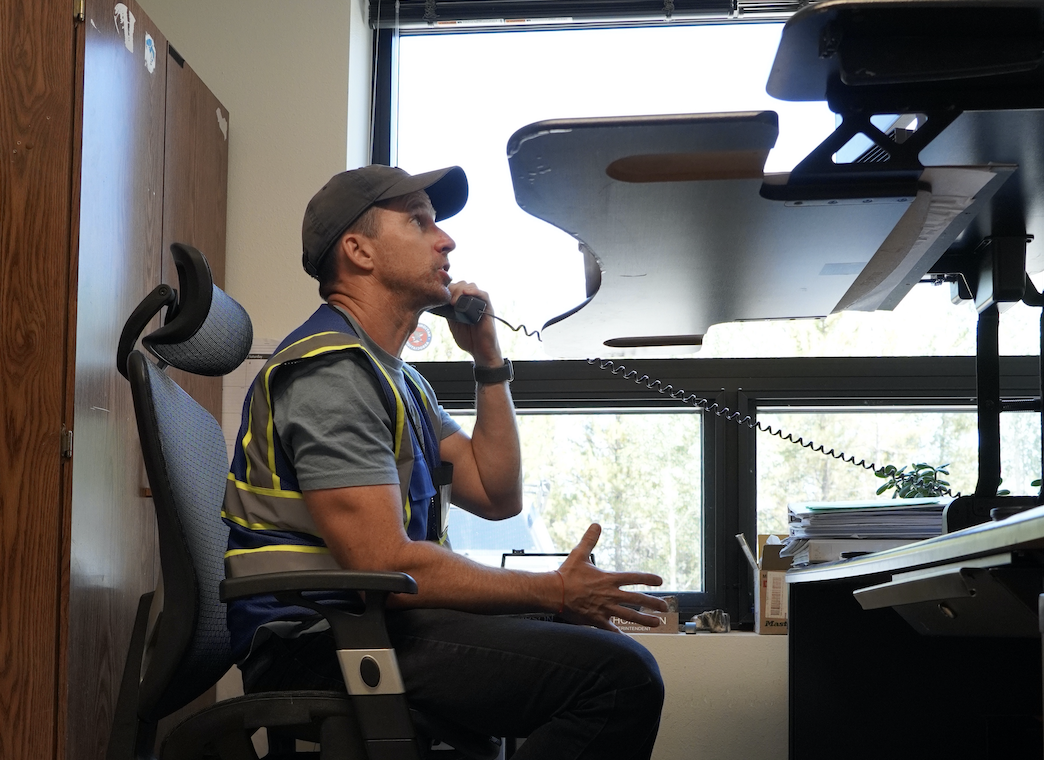
Stories
Getting started, learning the system, earning trust-
Carl Walker Tranquillo Pines, NM
CW: I grew up in Albuquerque, a native New Mexican. I moved up here in 1973. I bought a house right next door here to where the office is. And then the water system came in in 1978, actually, I'm sorry, 1974 is when they first started it, and through several different renditions and expansions, to its present size. I've been a member since ‘88. You have to be a member to be able to have a meter and be on the system. So I was just a member, the system ran fine for years, and then I was asked to be a board member about 12 years ago — something like that. So I said, sure, I always want to be a participant, you know, and be able to give back to the community. So I was on the board, and when I first got on the board, it was run a lot differently than it is right now. I didn't really have anything to do! We met maybe twice a year. The meetings were kind of short and brief and the manager at that time — the operator at that time — he ran everything. He did it all. So it was a different time, different place than it is right now.
So fast forward to 2024. We have an operator as a contractor right now. And we just operate under his umbrella. Our operator has several systems that he's going over — some need a lot of work. Our system has a very active board and, with a manager, we do all this stuff that the operator would do, except for maybe some of the tests. So like the heavy duty testing, I can't do, but the bacteria testing I do. So the system was falling apart fast. We put a new well online and we were pumping the heck out of it, everybody was happy. Then all of a sudden the pump, none of the pumps kept up. We just lost water, like overnight. A leak that did not surface — those are very difficult to find. So we were hauling water for probably — we still haul a little bit of water —but we were heavy for like a year. And we spent $250,000 on hauling water one year. $300,000 the next year. Yeah, so it was a lot, a lot that we did there.
So anyway, so the manager at that time, he completely got overwhelmed. I don't think he was doing a real good job of running the system from a managerial aspect. He had a difficult time making decisions and he had said that he wanted to retire; he's going to get out, like in September of ‘24. So, Gary, the president approached me and is like, “Carl, do you want to take this job?” “No. I don't wanna take this job. It's a thankless job and this thing's going downhill!” So he kept recruiting me and I kept resisting and then the manager at that time, he made some stupid decision and I was like, “okay, I'm in, because I know I can do better than that.” So, I got about a month's training and then I jumped in the seat.
My first week that I was in this job — I was very lucky. They had a conference down in Las Cruces, the fall water conference that they have that New Mexico Rural Water puts on. I went down there for the whole week and attended everything that I could. I was there from the opening bell to the closing bell and it was really good. I really got connected with a lot of people. That's one thing that the conferences are great for — for connection, for networking. It was really good. I met a lot of people from the environmental department and some other operators too. Which was really nice. So that was really good. Then I jumped into it. You know, I came back up here. Knew nothing about it, knew nothing about — other than what I knew from the board to this — so it was really intense. The old operator left, the old manager left, so I took over. The whole system pretty much financially crashed in January of ‘25. We had like, 200 bucks in the bank and 7000 dollars in debt.
EE: Why did it crash?
CW: The water haul was bigger than what they anticipated and we didn't have money to pay for water haul, and then everything else that happens too. There's a lot that goes on with it, you know? We have tank contracts — we have a contractor that maintains our tanks, and that's $3500 every quarter. We didn't have money for that and repairs and things like that. Plus, on top of all that, that was the year that we had the big deep freeze up here. We had 10 meters freeze up. What do I do? We went around and I was able to thaw a couple of them out, replace some. It took several months to replace some of them. Some of them were summer homes, so we kind of held off on them. That was a huge, huge thing. Well, I worked 33 years, my previous life was 33 years at UPS. It had 33 years of peak season — going through Christmases. This was harder than any Christmas! Yeah, it was tough. We managed to get through that. Much to the chagrin of all the members, we raised the rates a lot. That's finally gotten us out — a year and a couple months later, we got some money in the bank. We’re able to pay our debts. We’re actually moving in the right direction. So, that's one of the things too, that as we move forward, we're looking to get grants and loans. We need to prove to the New Mexico Finance Commission that we can pay these loans back, and I think that we can do that now. So, it's in a lot better position financially. Plus all the paperwork and everything else, it took a lot.
EE: Did something shift in the community that allowed them to pay more for fixes?
CW: Uh, it depends on the people. Some are understanding others: “I'm out.” They saw no value in the meter at all,some gave their meters away to other people. You know, you talk to a real estate agent, and that meter is on a piece of property, it increases that piece of property by like $30,000. People saw no value in it because they didn't have any faith in us, I guess. But the board has really come a long ways, becoming mutual domestic — which is a quasi-state government entity — really changed a lot of that aspect. Because now we're more open. We have our monthly board meetings, they're open to the public. We publish everything. Everything is above board. So that’s good right there. That'sdeveloping more trust. Plus, we worked real hard to locate and repair the leaks.
EM: With the town of Silver, that's different, I've had a number of big items that have happened there. Everything from we had, we've had lightning strike, a major pumping system that took out our entire control panel.
EE: Wow.
EM: All controls for the building were basically, non-operational, they would have had to been replaced. And so, it was in the middle of summer, when water use is extremely high, and our system, like I said, is leapfrog, so we have the wells, well fields pumping into one set of tanks from there, gravity fed to another set of tanks which then boosts to our middle set, W Mountain, which then boosts to another set of tanks in PA. And right in the middle, which is our swan street, that's what got struck by lightning, I literally knew I was on the clock, I had two days to find a way to start pumping water up to the, the tanks, or else I was gonna have a major issue for all the northern side of town, as well as the community of Pinos Altos, which is a small town, just north of Silver City, which gets water from Silver. That was, that was pretty nerve-racking once we found out how much damage was done. We were able to test our well or our motors on our boosters,those were fine, thank goodness. We were like, great, we were.
EE: How soon did you know that it was out?
EM: Luckily, we had automation there, so it notified us the moment that struck, that strike happened, we were out there. We got there, we saw the damage and there was no, you couldn't miss it. The boxes were blown up, literally.
EE: Wow, like black.
EM: Yes, black.
EE: Exploded.
EM: Yes, completely, what we didn't know at the time was, it had also created an issue that the transformers for the power company. Under no load, it would show a regular voltage of four hundred and eighty, but the moment you put a load to it, it would go to full load amps, like 17,000 volts. Yeah, they didn't know that at the time, but we were still trying to figure out what do we do? We can't, we can't order a control panel immediately. If so, it was so specialized that it was going to take us weeks, we had two days. We realized, okay, so we had a certain size of motor there, which was a hundred horse motor and like I spoke before, we had just bought, we had just upgraded our well fields with new motors and new control panels. So we decided we were going to go to one of the wells that was least in rotation, and we basically, which was a hundred horse motor, and we completely took all of the electrical components out, the entire box, put it in our truck, and drove it to the pump station, and begin helping the electrician wire it in.
EE: Wow, good thinking.
EM: Yeah, that was the only thing we could think of to get us water within twenty-four hours.
EE: And then did you have to order a new panel?
EM: Yes.
EE: That still took a few weeks to...
EM: Yeah, actually, because it, you know, it was a lightning strike. It was one of those insurance policy type things, so it did take some time, but we were able to replace those. While that was being done, we had our temporary fix, so, it worked out great. We were able to have that system up and running within the day. I think it took us a day to get everything taken care of. It wasn't on our side what ended up happening was once we got our control box wired in, werealized that there was something wrong with the incoming power as our box would shut off and then the power meter would blow up. Which PNM, our power company, saw that, realized, and had to bring in, they too, they don't necessarily have transformers just laying around. Luckily, they were able to get a new set of transformers in, that was our biggest concern was the wait, but we got that in and we were back in operation within a day and a half; thanks, no one knew, no one knew what had happened, no one knew.
EE: I was gonna ask if any, if the community was aware, no?
EM: No.
EE: Wow.
EM: They had no idea.
EE: What's that like having a job that's so important but so invisible?
EM: I don't mind it, to me, it was nice. I knew that, it's important, a lot of people don't realize how important it is until you don't have water.
EE: Right.
EM: You know, it's something that's required for everything. I take, I took pride again, it's my system, if I'm the operator, if my name's on that thing, I want to make sure that everything's on par. My biggest thing on that north side is the dialysis clinic and the hospital, both receive water from the north end, so that was my biggest concern was how many people were not going to be getting service through the dialysis clinic or the hospital, you know, being without water. We also were looking at how we could change and which we did, during that time we were looking at water. It would have been a lower pressure water; some water to the hospital, but it's nice, I don't mind being invisible.
The Future of the Water System-
Billy Pierce Bolinas Community Public Utility District, CA
BP: To go back to things that have happened, incidents in town -- back in the ‘80s, early ‘90s-- we have two water storage tanks. They both needed maintenance and repair. So, we took one of our tanks out of operation. We were just relying on one tank, which was enough to provide water for the town for a while; for several days. That tank was being worked onand we had a series of really big storms hit and as a result of that, our water quality was poor coming into the plant. We were restricted on water treatment, so the surge level in the tanks had dropped considerably. Then we had a big overnight storm hit and we had an unfortunate series of coincidences that led to a total disaster. The power was knocked out. The standby generator did not start. We weren't producing water. The water storage tanks were at about 50%. When I came in the morning, the water storage was at a hundred thousand gallons, which is not a good sign. I could see the water gauge dropping, so overnight we had a pipe break in town which was draining the system. The pipe broke, one tank's out of service, the other tank's almost empty, the generator didn't start. We weren't producing water, and we were restricted on the amount of water we could produce. The result of that was a decision we made -- we had to shut the system off. Turning a water system off is not a good thing. The water system basically drained, the whole distribution system. People didn't have water, so we were in a total state of emergency. We notified the state. We put in a boiled water notice. We have a disaster council for emergencies, they came in and they were activated. All the community leaders came in and we had to restart the system. We had to shut valves in the system going backwards. That's not correct -- we went to our first set of valves that are after the water storage tank. We shut that, we got the filter plant working and started putting water back in the tank. We isolated the whole system because we didn't have a clue where the leak was. We slowly started the system back up. In starting the system back up, the water is not potable. You can'tdrink it. The pipes have been empty. They have to start testing the water, but we are fortunate. My son had just come back -- he was in the army and just came back from Bosnia -- and he is a public health officer, so he was able to help us with water testing. We had a lot of volunteers-- a hundred volunteers showed up. We started putting the system back online, doing water sampling and a nonstop convoy of running samples to Santa Rosa where their lab is (or at that time it was in Nova
Elevated water tank divers-
Eddie Mendoza Tyrone Town Site, NM
EE: What other kinds of problems have you encountered on the job? Love to hear some stories.
EM: Let's see, we have, for Tyrone, we had an issue with our water tank. Tyrone is very strange as it, it has an elevated storage tank, which isn't strange for New Mexico, where there's flat areas, but because we're in the mountains, it's strange to see an elevated storage tank here, but the mine itself; who owned Tyrone before, was basically using the water pressure from the town of Silver to fill the tank up, and it would maintain its own pressure for the system here. That was pretty smart, but, again, it was built in the 1960’s. One day I went, and we were leaking from the bottom of the tank, which is connected to our altitude valves vault, which meant that I couldn't change anything for the vault until I pumped the water out, but the danger of being in there was quite high.
EE: In the tank?
EM: In the vault because water was coming from the tank into the vault. It was basically a trap because you have to get in and down this little access point to work on the altitude valve that controls the tank, but it's constantly being underwater. We had to get that fixed, but what was strange was, I thought this was only an easier, you know, an easy fix or a normal thing, so I contacted almost everyone I knew that had any elevated storage tank, and they weren't sure. They didn't and they hadn't run into that issue.
EE: How high is it in elevation?
EM: It is ninety feet, ninety-six feet to the top, so it's quite a ways up there. After some, many phone calls, and pumping out to make changes in that vault. I was able to contact a diving crew out of Farmington, who was willing to come in and basically dive the entire depth of the tank to the bottom and epoxy a plate over the leak. The leak was actually, a weld from the drain line that had given, so hence why it was coming in because the drain line was traveling through that little vault where the pipes are. We were able to get that sealed off and we were like, okay, now we have a fire hydrant about a block away that's now our drain if we needed to drain the tank. That was pretty, pretty difficult…
EE: You don't need to drain the tank though?
EM: No, the problem with draining the tank is that this system requires that tank to be in line, there's no bypass. If I drain the tank, the town is without water.
EE: And that would create all kinds of problems.
EM: Absolutely, all kinds of problems. People are without water, and it triggers an immediate boil order, and everything else is going in with the regs, as well as notifying drinking water, that they would probably come in to see what's going on. We didn't want to drain the tank, so that was one of the things we did was we were like, okay, we're gonna get a diver, find the diver, who's willing to do it. The five diving crews that I used in the town of Silver, none of them wanted to do it, so I had to find somebody.
EE: Because it was so dangerous?
EM: Yes, they considered it so dangerous because of the depth and the unknown, because I had the schematics, but I couldn't tell them when the last time, the last portion, basically the stem, the middle piece going all the way to the sphere, had been dove, we didn't know. I didn't have any documentation on that, so they felt that that was too much of a risk. Luckily, I found somebody that was willing to do it, and they did a great job. It was done within an hour.
EE: Wow.
EM: Yeah, you know, it was weeks and weeks and weeks of preparation to get done in an hour.
EE: Well done.
EM: That was nice, yes, it stopped the leak, you know, and it was getting worse, so we were afraid that it would give in at that point, then we're in deep trouble for this little community, that was scary, but not too bad for Tyrone.
Operator-in-training-
Orlando Archuleta Santo Domingo Pueblo, NM
AO: It feels good for me to know I'm part of that, that we're building a wastewater treatment facility, upgrading all the infrastructure, and helping the guys that are here. With my knowledge to help them excel in their field right now, to help them, encourage them to get their certification. Most of the guys didn't have no certification coming in here.
EE: How many people work here?
AO: I can't think of one that has certification, only one certified. That's the reason they hired me. Oh no, our water transmission, our water operator, distribution operator has a level 3 in distribution. He's the only other guy that was certified beside me. Then we got our director from Cochiti — he came from Los Alamos, same place I used to work; I didn't know him though, but he knows a lot of people I knew. He has a certification also. And then just recently, one of our refuge truck drivers, CDL drivers, got his treatment too, Southwest Environmental Finance. He got his distribution 1 and his treatment 2 just a couple weeks ago. So we're really happy with them. We had other guys test, of course, they didn't pass, but we're telling them not to give up. Keep helping with the best way we can, you know? So bring in trainers or, you know...
EE: How many people are on the team?
OA: We have a total of 12 now. We have an engineer they hired last year — I don't think they've ever had a water and wastewater engineer. Then we hired an OIT just recently... There's a problem with finding operators. A lot of operators have already retired two times, they're on their 3rd career with being a water and wastewater operator, because it's a shortage, right? And what I learned in California is that they help recruit people, they started operator-in-training. I got that idea when I came back, because I was seeing the same situation in New Mexico. At Sandia, I was able to convince them to start a program for operator-in-training, and they were the first in the state of New Mexico to advertise.
EE: Does that mean on-the-job training?
OA: Yes, on-the-job training. They were the first In New Mexico to post an OIT position for water and wastewater — I bought that idea from California. That was back in 2021, I think. And with that program — we had a custodian that went through that program as an OIT, got his certification within 18 months, got double level 1s, we hired him and kept him on. Another guy was with farm services and he joined us in OIT, got his double level 1s. And then we hired some young people from outside of the tribe. They came in from a different pueblo and we hired them as OITS and they went on to get the certification also. So then I came over here and I brought that over here. We were having problems. I said, let'sdo an OIT and then they came up with their own job description for it. I know now the State of New Mexico, got that OIT in their language. I think they saw it off of us and then they made something with the state as far as OIT level 1, 2, 3, and 4.
EE: Is it a good job?
OA: It's a lot of meetings. My whole schedule is nothing but meetings. Once in a while, when I get free time, I go out in the field and try to check up on the guys, help them if I can. I'm the only wastewater operator. Well, actually, the director's got a level 2, but he's busy doing all that other stuff. So I go and take care of the lagoons and monitor the lift stations, stuff like that. I'll go out and build and help, wherever I can. Time permitting, if I don't have a meeting or something.
EE: It sounds like whenever you decide to retire, you might have people who are in place to take over…?
AO: Well, that was my whole idea! My goal coming here was to get as many people as I could certified before I left, so that when I retire, they'll be taking over that plant. There'll be operators. We're on the good path of getting these guys, keep working with them to get trained, and to hire more certified operators. Right now we're working with New Mexico Rural Water Apprenticeship Program. So we've recommended two of our W9 workers — W9 workers are temporary workers that we use for feast days or if we need them to do stuff around here, they're not full time. So we've had residents that we've helped out that way — that helped us out and we've recommended them to sign up for this program. We're currently trying to get them hired on as OITs through the apprenticeship program. Once they get their certification, then we'll hire them full-time.
EE: So if somebody's kind of on the fence or thinking about this as a career path, what would you say to convince them?
OA: I would say that the certification that you obtain is yours. It's a professional certification that you can reciprocate throughout the whole United States. So, if you have a level 4 in New Mexico, California will give you a level 4 straight across. Some states will drop you one or two levels; they'll still reciprocate it. The same way they treat waste water and water here in New Mexico, they do the same thing in Germany, in Japan. Language is different. Technologies are the same. You know, MBRs, SBRs, activated sludge, nitrogen rule — it’s all the same. The process is universal. There's a language barrier, but if they sent me to Kuwait to go look at one of their plants and I didn't understand, I could operate it because I would know what to do. If I had the equipment, I would know what to look for and know how to take care of everything. That never changes, no matter where you are. This career, you can work anywhere. You can do anything.
Next Story Page -->